Swiss Alpine Tunnel Travel and Offline Puzzle Gaming Among Commuters
Geschrieben von Elena Hughes · 24.8.2026

Swiss Alpine Tunnel Travel and Offline Puzzle Gaming Among Commuters
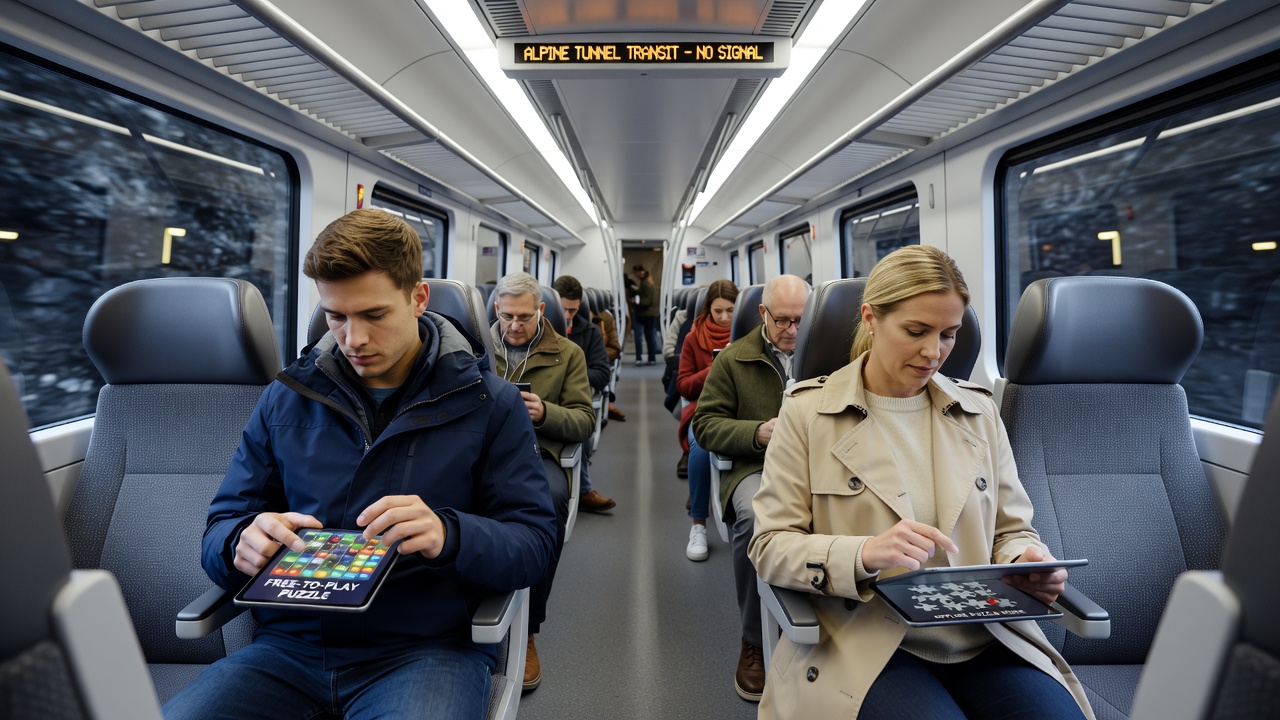
Swiss rail networks carry thousands of daily commuters through extensive alpine tunnel systems where mobile connectivity drops for extended periods, and this environment has shaped reliance on offline-capable free-to-play puzzle modes in games that otherwise include action elements.
Data from the Swiss Federal Office of Communications shows that tunnels such as the Gotthard Base Tunnel create connectivity gaps lasting between eight and twenty minutes on standard routes, while shorter tunnels in the Jura and Bernese Oberland regions add cumulative interruptions that affect real-time gameplay features.
Connectivity Patterns in Major Alpine Routes
Commuters traveling between Zurich, Lucerne, and Bellinzona encounter repeated signal loss because the infrastructure prioritizes rail operations over continuous cellular coverage, and operators have documented these blackouts through network performance reports released in 2025. Free-to-play titles respond by enabling puzzle modes that function without server connections, allowing match-three sequences, logic grids, and tile-based challenges to proceed uninterrupted while action sequences requiring online validation pause automatically.
Those who study mobile usage patterns note that puzzle completion rates rise sharply once trains enter tunnels, with session data indicating users switch modes within thirty seconds of signal loss and maintain engagement until connectivity returns.
Game Design Adaptations for Offline Reliability
Developers have adjusted action game frameworks to embed modular puzzle components that operate independently of cloud services, and this separation lets core progression systems continue when real-time multiplayer or live events become unavailable. Research from ETH Zurich on mobile entertainment consumption highlights that games incorporating these hybrid structures retain higher daily active user numbers among Swiss commuters compared with titles that rely solely on constant online checks.
Design choices now include pre-loaded puzzle libraries that sync progress upon reconnection, reducing data loss and supporting seamless transitions between offline and online states without player intervention.
Usage Trends and Regional Data
Figures from the Swiss Federal Railways passenger surveys reveal that approximately 42 percent of mobile gaming sessions on alpine routes involve puzzle modes activated specifically during tunnel segments, whereas action-heavy sequences resume only after exits where signals stabilize. In August 2026, network expansion projects along the Simplon route introduced partial 5G coverage in select tunnels, yet full continuity remains limited and commuters continue to depend on offline capabilities for consistent play.
Industry reports from the European Games Developer Federation document that studios targeting European markets have increased investment in offline puzzle modules by 28 percent since 2024, citing commuter feedback from alpine corridors as a primary driver for these modifications.
Effects on Action Game Mechanics
Action game design now frequently incorporates puzzle interludes that serve as pacing mechanisms, allowing players to maintain momentum during connectivity gaps while preserving the integrity of high-intensity sequences that demand stable connections. This approach prevents abrupt session terminations and supports retention metrics tracked by analytics platforms used across multiple development studios.
Observers note that games blending these elements show improved cross-platform compatibility, since puzzle assets require fewer device resources and function reliably on both older handsets and newer models common among Swiss rail passengers.
Conclusion
Swiss commuter behavior during alpine tunnel travel demonstrates clear patterns of offline puzzle mode adoption that have prompted measurable shifts in action game architecture, with developers prioritizing modular offline components to accommodate regional infrastructure realities. Data from regulatory and academic sources continues to track these adaptations as tunnel networks evolve and mobile gaming remains integrated into daily transit routines.